Lawyers found 29 partners in two weeks

Since 2008, a law firm has been helping online schools, children’s centers and continuing-education courses get licensed and operate legally. Its clients come through referrals, so the VoKo AI agent looked for the people close to the schools: marketers, producers, web studios and platform tech specialists.

16 daysPeople around online schoolsCommission per client
Cost per partner$12.50
Sales coachonline
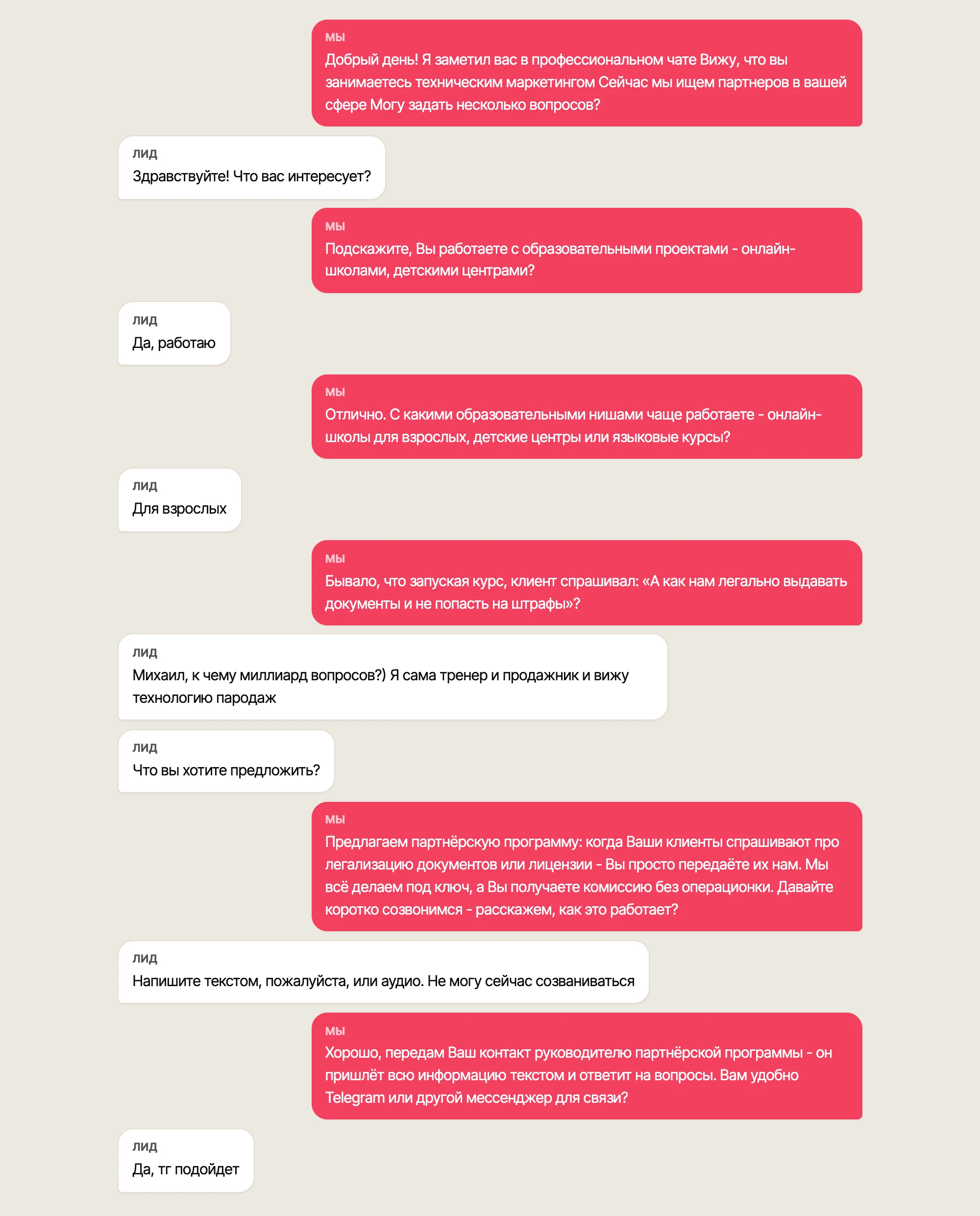
…what’s with the million questions?) I’m a coach and a salesperson myself…
What do you want to offer?
We offer a partner program: when your clients ask about legalizing their documents or getting licenses, you simply pass them to us. We do everything end to end, and you get a commission with no operational work…
Please send it as text or audio. I can’t do a call right now
1,467messages to specialists around online schools in 16 days
16%replied, that is 239 conversations
29partners agreed to a call or to terms in writing
$12.50cost per partner in this case
Updated . Figures from the project dashboard.

In short

  1. Who we wrote toMarketers, launch producers, web studios, platform tech specialists, instructional designers and trainers. They count online schools among their clients and don’t have an education lawyer of their own.
  2. What we offeredA partner program with a commission for every referred client. Payouts are visible in a partner dashboard, and the partner’s client gets the first consultation free.
  3. ResultsIn 16 days the agent sent 1,467 messages and got 239 replies. 29 people agreed to a call with the head of the partner program or asked for the terms in writing.
  4. Where the agent stopsThe agent doesn’t name commission amounts or go into legal details. It asks for a phone number only after the person agrees, and the head of the partner program discusses the terms.
01

We wrote to the people an online school asks first

A school remembers about licensing once it has issued its first certificates, received its first refund demand or got a letter from Rosobrnadzor, the federal education regulator. At that point it asks the producer, the marketer or the tech specialist who set up the platform, and goes to whichever lawyer they name. The database of 1,472 contacts was built from an export of education-platform specialists and the client’s own list.

1
Marketers and producersThey launch courses and are the first to hear the question of how to issue certificates legally
2
Web studios and platform tech specialistsThey set up the LMS, payments and websites, and they see the moment a school starts issuing certificates
3
Instructional designers and trainersThey build the product with the school owner and know who will soon need a license
02

239 replies and 29 partners in 16 days

Each contact got one message. Sending ran from July 6 to July 22 from seven accounts. The lists from education platforms produced a 19% reply rate, and the client’s list produced 14%. Two thirds of the rejections came from people with the wrong profile, most often tech specialists who never get legal questions. That is why we will split the database by role before sending on the next launch. Only the client knows how many partners signed an agreement and how many clients they brought, and we don’t include that in the cost per partner.
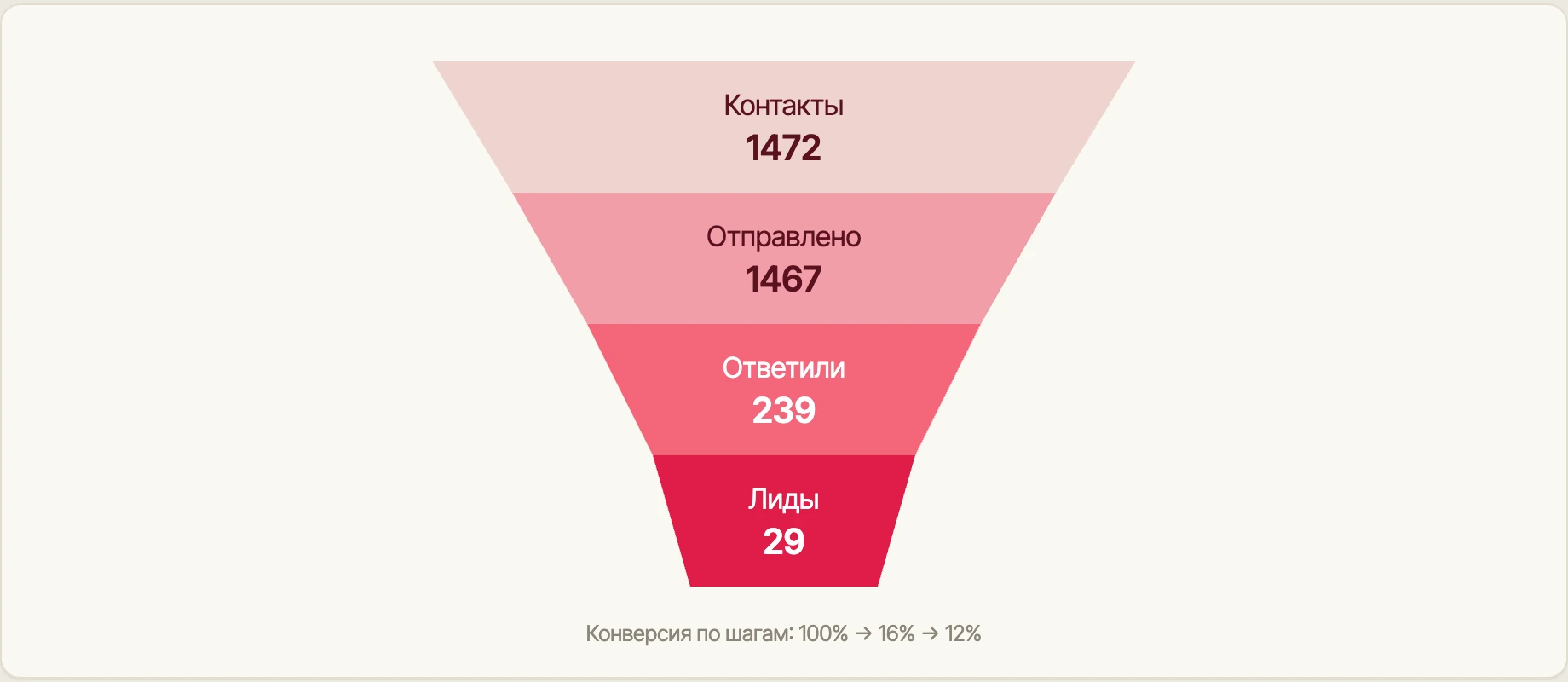
Project funnel from the client dashboard (in Russian): contacts 1,472, sent 1,467, replied 239, leads 29
1,467
239
replied16%
29
partners12% of those who replied
34 smedian agent response time
5.1messages per conversation on average
63%of replies came at 9–11 AM or 6–8 PM, Moscow time

Three of the five partners handed over were already sending clients to a lawyer they knew and getting nothing for it.

3 of 5partners already recommended a lawyer for free
1 of 3of those who agreed asked for the terms in writing instead of a call
8 of 239conversations stretched beyond a day
Observations from the conversations in this project

Three conversations from the project

Screenshots from the client’s dashboard page, in Russian. The company name, the partner program name and phone numbers are hidden, and the wording has not been edited.
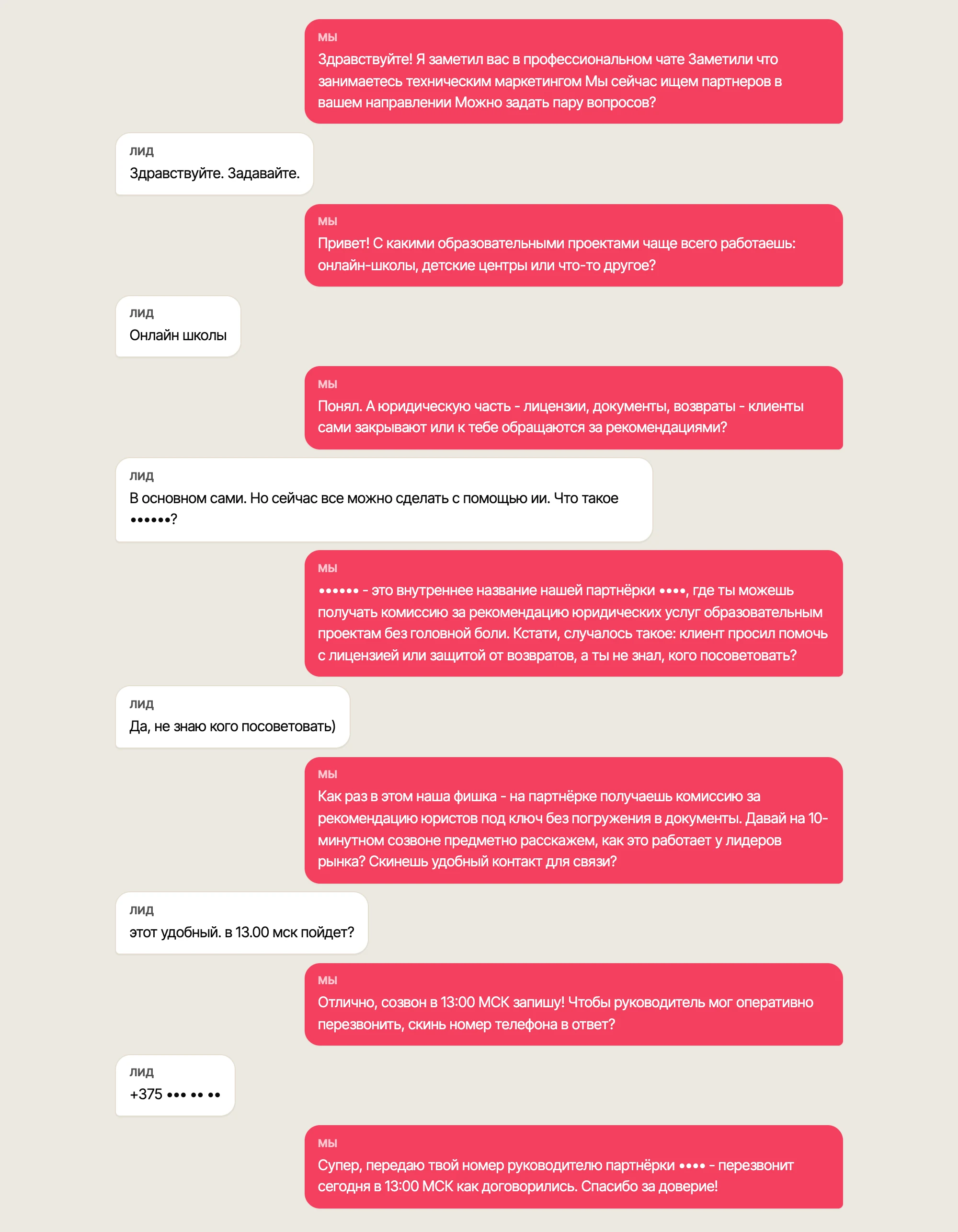
Telegram conversation (in Russian): the agent asks which schools the person works with, answers a question about the partner program, and gets agreement to a 1 PM call and a phone number
01“I don’t know who to recommend”After two clarifying questions the person named the problem themselves. The agent suggested a ten-minute call and asked for a number only after the reply “does 1 PM Moscow time work?”. It took 59 minutes from the first reply to the number. In this conversation the agent switched to the informal form of address, and after that the rule to use the formal one was enforced more strictly.
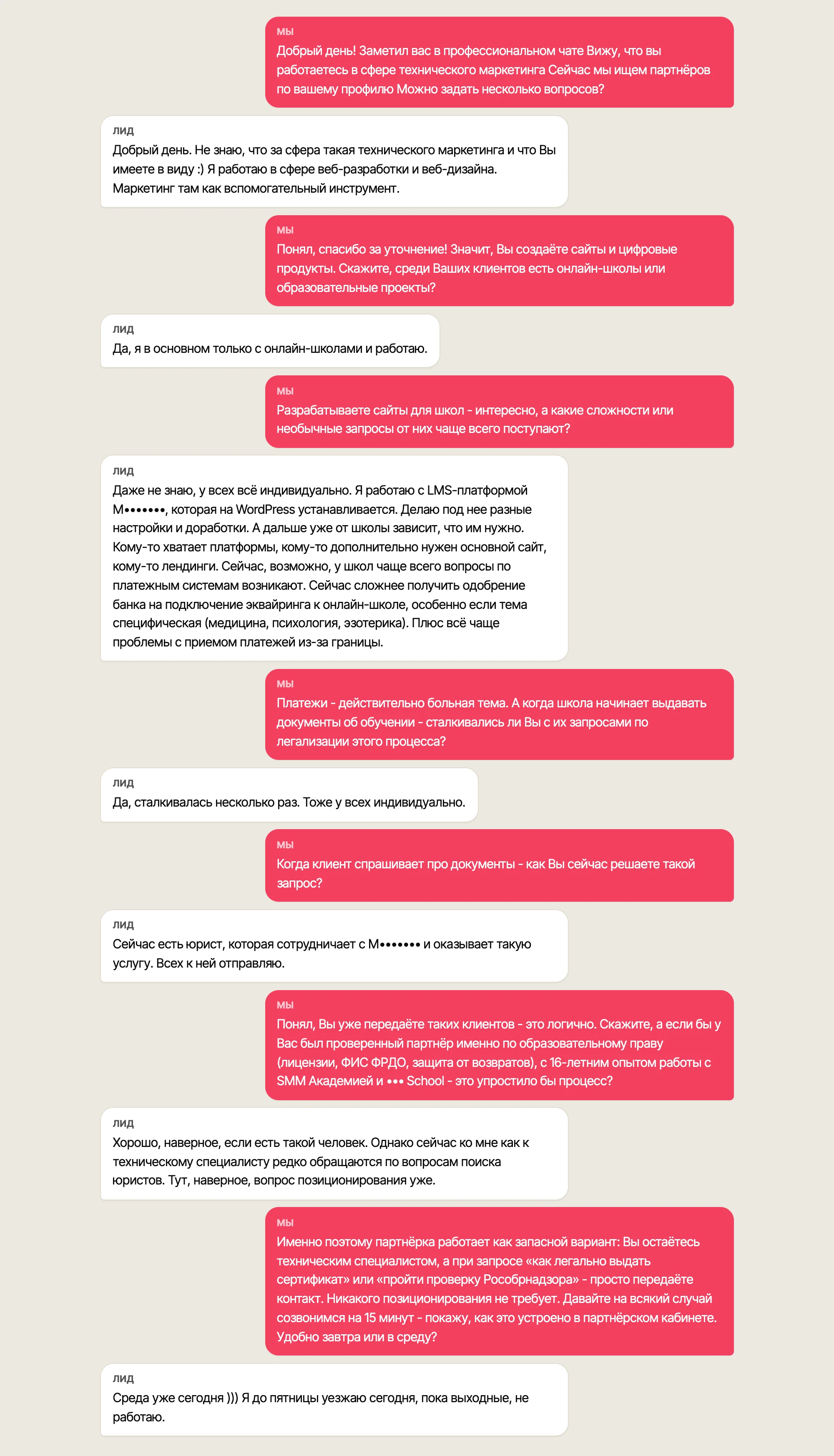
Telegram conversation (in Russian): a web developer explains that she sends clients with certificate questions to the platform’s lawyer, and the agent offers the partnership as a fallback that doesn’t change her positioning
02“I send everyone to her”A web developer works only with online schools and already sends clients to the platform’s lawyer for free. The agent offered the partner program as a fallback that doesn’t require her to change how she positions herself.
Telegram conversation (in Russian): the person asks the agent to stop asking questions and say what is on offer, the agent briefly explains the partner program, accepts the request to send details in writing and passes the contact to the program head
03“What’s with the million questions?”A sales coach demanded to hear the offer right away. The agent explained the setup in one message, and when she asked to get it in writing, it passed her contact to the head of the partner program. This conversation counts as a lead.

FAQ

Does the agent understand education law?
The agent knows exactly as much as a conversation with a partner requires: licenses, FIS FRDO (the federal registry of education certificates), refund protection and inspections. It takes every fact from the client’s brief. If the brief has no answer, the agent passes the question to the head of the partner program. It stays out of legal details, because the client didn’t want legal advice given in the chat.
Why a 16% reply rate and not 30%, as in other cases?
A partner offer is colder than a customer offer, because the person is offered a way to earn from someone else’s problem rather than a fix for their own. Part of the database also turned out to be tech specialists who never get legal questions. Lists from education platforms produced a 19% reply rate, and the client’s list produced 14%. Next time we’ll split the database by role before sending.
What counts as a partner?
A partner is a person who agreed to a call with the head of the partner program, or asked for the terms in writing and was handed over to the program head. A reply like “interesting, I’ll think about it” doesn’t count. In this project there were 29 such partners out of 239 people who replied, and about a third of them chose written terms instead of a call.
How fast does a partner reach the program head?
As soon as the person agrees. The program head gets a Telegram notification with a link to the conversation, which shows which schools the person works with, what interested them and what was agreed. The program head picks up from there instead of starting the introductions over. The agent replies in 34 seconds on average, so the conversation doesn’t cool off.
How much does it cost?
The price depends on niche, geography and volume. Every project has its own database and sending volume, so in another niche or region the cost per partner will differ from the $12.50 in this case. We prepare an estimate for your project within one day. Message us on Telegram at @VoKo_support.

Do your clients come through referrals?

We’ll work out for free who stands close to your clients and where those people talk, show you a test conversation with the agent and estimate how many partners to expect from the first launch.

Get an estimate on Telegram